
Finding the Right Kit
A full adult kit for a five-year-old is like giving them a car to ride to school. Size matters — here's what actually fits.
"The number one mistake parents make? Buying a full-size kit and hoping the kid grows into it. That's like giving a toddler size-12 shoes and saying 'they'll fit eventually.' Let's measure first."
— Tempo's Rule #1
Junior Kit (3-piece)
💡 Look for height-adjustable stools. Their feet should rest flat on the floor.
Junior/Student Kit (4-piece)
💡 This is the sweet spot — most kids this age can start with mesh heads for quieter practice.
Full Student Kit (5-piece)
💡 If they're serious, a mid-range acoustic or quality e-kit here will last into their teens.
📏 Free Drum Kit Sizing Chart
Print it, bring it to the music store. One page covers ages 3–12.
Setting Up the Space
No, you don't need a soundproofed studio. You need moving blankets, a pool noodle, and the knowledge that most of the noise lives in the bass.
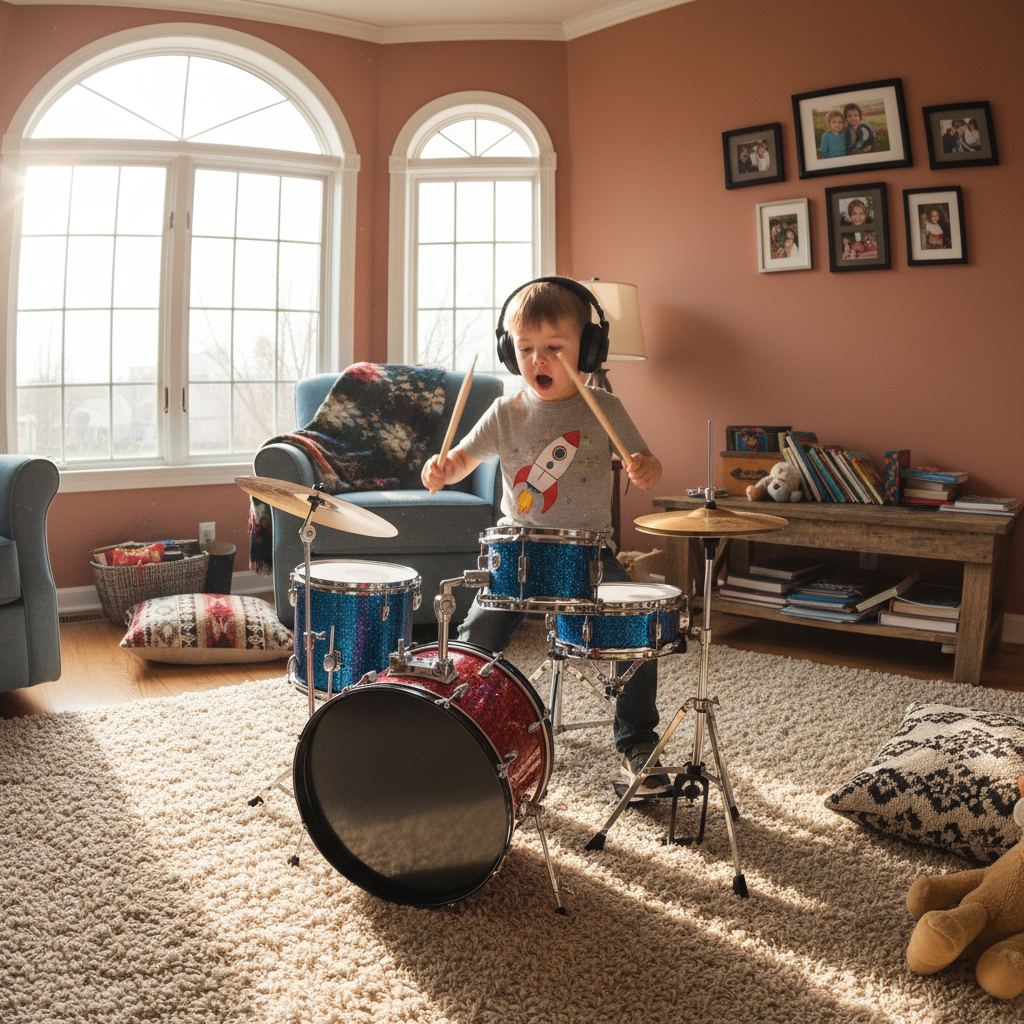
"The garage with a rug and two moving blankets will always beat the living room with hardwood floors. Surfaces matter more than walls."
— Tempo on room acoustics
Moving Blankets on the Walls
Hang 4–6 moving blankets on the walls facing the kit. They absorb mid and high frequencies — the ones that travel through drywall.
Pool Noodles Under the Bass Drum
Slice a pool noodle lengthwise and wedge it under the bass drum. It decouples the drum from the floor so vibrations stop traveling.
Rugs on Every Hard Floor
Layer two rugs under the kit footprint. The thicker the pile, the more low-end vibration you absorb. Carpet offcuts from flooring stores work great.
Door Draft Stoppers
Sound leaks through door gaps more than walls. Draft stoppers on every door in the practice room cut sound bleed to the rest of the house significantly.
Mesh Heads + Riser Pad
For apartment parents: swap acoustic heads for mesh, add a drum riser isolation pad underneath. Neighbors will barely notice.
Bookshelves as Bass Traps
Fill a bookshelf with books and place it in room corners. Irregular surfaces and mass break up bass frequencies that would otherwise resonate.
Real numbers: How loud is a kids' drum kit?
An acoustic kit registers ~90–100 dB at the drummer's ears. Mesh heads drop that to ~65–70 dB — roughly the volume of a normal conversation. An e-kit with headphones: ~55 dB. For context, your neighbors start noticing around 70 dB through walls. Plan accordingly.
Surviving the First Month
Month one is loud, messy, and — if you know what to look for — secretly full of tiny victories.
Week 1–2
The Banging Phase
What's happening
Everything is loud, random, and chaotic. This is correct.
Your job
Let them explore. Don't correct. Don't teach. Just let them hit things.
🏆 Milestone to celebrate
They start hitting the same drum on purpose. That's it. That's the milestone.
Week 3–4
The Pattern Emerges
What's happening
They'll find one beat they like and play it 400 times.
Your job
This is the best sign. Repetition is how the brain learns rhythm.
🏆 Milestone to celebrate
They ask to play again tomorrow. That's the real win.
Month 2
The First Real Beat
What's happening
A basic kick-snare pattern starts to sound like actual music.
Your job
Record a video. You'll want this later. Also: it's okay to cry a little.
🏆 Milestone to celebrate
They play along to a song on the radio, even imperfectly.
Six Things That Actually Help
Set a practice timer (15–20 min is plenty). When the timer ends, the drums stop — no negotiation, no exceptions.
Put on music they love while they play. Playing along to songs they know accelerates rhythm development by weeks.
One rule: we play when we're happy, not when we're frustrated. Anger-drumming sounds bad and teaches bad habits.
Film a 30-second clip every two weeks. Progress feels invisible day-to-day. The videos will shock you.
Ear protection for you and them. Always. Kids' hearing is more sensitive than adults'. This is not optional.
Celebrate specific things: "I loved how you kept that beat steady for a whole minute." Specific praise > generic praise.
"I've seen it hundreds of times. The kid who's 'too wild' in week one is usually the one playing real songs by month three."
Teacher vs. Learning at Home
Honest answer: it depends on your kid's age, your budget, and how much you want to be involved. Here's the full breakdown.
Private Teacher
✓ Advantages
- ✓Corrects bad habits before they become permanent (grip, posture, timing)
- ✓Structured curriculum means nothing gets skipped
- ✓Accountability — kids practice more when someone else is watching
- ✓A good teacher feels the music with your child, not just at them
- ✓Recitals and group lessons build confidence
✗ Trade-offs
- ✗$40–$80 per lesson adds up fast — budget $160–$320/month
- ✗Finding a teacher who's good with young kids (vs. just good at drums) takes time
- ✗Commute time twice a week
- ✗Structured lessons can feel rigid for very young kids (under 6)
Learning at Home
✓ Advantages
- ✓Free — YouTube channels like Drumeo Kids and The Drum Ninja are genuinely excellent
- ✓Goes at the child's pace, not a curriculum schedule
- ✓Practice happens on your family's schedule
- ✓Great for ages 3–5 when exploration > structure
- ✓Can switch to formal lessons later with no lost ground
✗ Trade-offs
- ✗Easy to develop bad grip habits that are hard to unlearn later
- ✗Requires parent engagement — you need to know enough to spot obvious problems
- ✗No accountability structure unless you create one
- ✗Progress can plateau without outside perspective
Tempo's Age-by-Age Recommendation
Ages 3–5
Home-led exploration
Structure frustrates this age. Let them play freely with YouTube guidance. Formal lessons rarely stick before 5.
Ages 6–8
Either works well
If they're asking to play regularly, a teacher accelerates them. If they're still exploring, home is fine.
Ages 9–12
Teacher recommended
At this age, bad habits compound quickly. A teacher 2x/month minimum pays for itself in long-term progress.
"The best teacher in the world can't replace a parent who sits in the room, watches, and says 'that sounded really cool' once a week. You don't need to know anything about drums to be the most important person in their drumming journey."
🎓 Finding a teacher: Search "kids percussion teacher [your city]" + ask your local music store for recommendations. Always observe a trial lesson first.
First Kit, First Beat
A live 60-minute session with a kids'percussion teacher. We'll set up a starter kit on camera, teach a first beat, and answer every question you've been afraid to ask.
What happens in 60 minutes
Kit Setup on Camera
Watch a real kids' kit get set up from scratch. Stool height, pedal position, the works.
Stick Grip & First Hits
The two grips, which one fits your kid's age, and why it matters for wrist health.
The First Real Beat
A simple kick-snare pattern your child can learn in one session. We'll teach it to the parents too.
Open Q&A
Bring your questions. Kit recommendations, space concerns, sibling noise wars — all fair game.
"By the end, your kid will have played their first real beat. And you'll know exactly what to buy, what to skip, and what to expect."
Save Our Seat
Free. No credit card. Just show up.
We'll send a Zoom link 24 hours before your session.
What parents say after attending
"I went in knowing nothing about drums. I left with a shopping list, a setup plan, and a kid who hasn't stopped talking about it since."
Michelle T.
Mom of a 7-year-old, Chicago
"The teacher showed us exactly how to hold the sticks in the first 10 minutes. My son had been holding them wrong for a month. Game changer."
David K.
Dad + former bassist, Austin
"I bought my granddaughter a kit after this workshop. Turned out I got the right size. That never happens when I shop for instruments."
Carol M.
Grandparent, Portland
Not ready for the workshop yet?
Still figuring out the right kit size?
Download the free Drum Kit Sizing Chart — one page, every age, ready to print and bring to the music store.